
Terms and Conditions
What are Terms and Conditions?
**Terms and Conditions (T&C, also known as Terms of Service (ToS) or End User License Agreements (EULA), are legal agreements between a service provider (business) and the users of that service, outlining the rules, responsibilities, and restrictions for using the provided services or products. They set forth the legal basis of how users can interact with the business and what is expected of both parties.
Why are Terms and Conditions Important?
Legal Protection:
- T&C provide a legal framework that protects the business by limiting liability, governing user behavior, and defining the consequences of violations.
Expectation Management:
- Clear terms help users understand what they can expect from the service and what is expected of them in return, which can reduce disputes.
User Rights Clarification:
- T&C outline the rights of both users and the service provider, clarifying ownership of content, payment obligations, and user obligations.
Regulatory Compliance:
- Many industries are governed by regulations that require clear communication of terms; having T&C in place helps ensure compliance.
Dispute Resolution Framework:
- By outlining procedures for resolving disputes, T&C provide a process to follow should issues arise, reducing ambiguity and potential litigation.
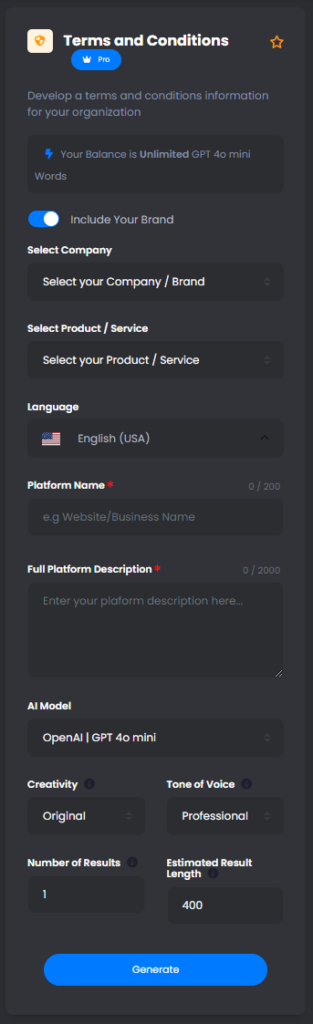
How to Write AI Terms and Conditions Using Empror
Access Empror:
- Log in to your Empror account or create a new account if you do not have one.
Locate the Terms and Conditions Generator:
- Find the specific feature within Empror that is designed for generating Terms and Conditions documents.
Input Key Information:
- Enter necessary details about your business, such as the name, type of services or products offered, and any specific legal requirements relevant to your industry.
Specify Important Sections:
- Identify the key sections that should be included, such as user obligations, payment terms, intellectual property rights, limitations of liability, and dispute resolution.
Customize Content:
- Empror may allow you to specify any additional clauses or unique requirements that pertain to your business model.
Generate the Terms and Conditions:
- Submit your input and allow Empror to create a comprehensive and tailored Terms and Conditions document.
Review and Edit:
- Go through the generated T&C to ensure all details accurately reflect your business practices and legal requirements. Make any necessary edits for clarity or specificity.
Finalize and Publish:
- Once satisfied with the document, publish the Terms and Conditions on your website or app, ensuring they are easily accessible to users.
Benefits of Writing AI Terms and Conditions
Time-Saving:
- AI tools can quickly generate a T&C document, drastically reducing the time it takes to create one from scratch.
Legal Compliance:
- AI-generated T&C often incorporate standard legal language and clauses that help ensure compliance with applicable laws.
Customization:
- Generating T&C with AI allows you to tailor the content to meet the specific needs and practices of your business.
Consistency:
- AI can ensure consistent language and structure throughout the document, making it easier for users to read and understand.
Cost-Effectiveness:
- Using an AI tool for T&C creation can be more budget-friendly than hiring a legal professional for the same purpose.
Regular Updates:
- AI tools can facilitate easy updates whenever there are changes in services, laws, or practices, allowing businesses to maintain current policies.
User Accessibility:
- Clear and concise AI-generated T&C can enhance user understanding, ensuring that users are well-informed of their rights and responsibilities.
Conclusion
Terms and Conditions serve as an essential legal contract between a business and its users, outlining rights, responsibilities, and limitations. Using AI tools like Empror to create these documents can make the process efficient, cost-effective, and tailored to business needs. The benefits include time savings, legal compliance, customization, and better user accessibility, all of which contribute to clearer communication and risk management. By investing in a well-structured Terms and Conditions document, businesses can protect themselves while providing clarity and transparency to their users.
(FAQs)
Frequently Asked Questions
Terms and Conditions (T&C) are legal agreements that outline the rules, responsibilities, and guidelines for using a website or service. They protect both the provider and the user by clarifying what is expected from each party.
Having T&C is essential for establishing a legal framework for your website. They help mitigate risks, protect intellectual property, limit liability, and provide clarity on user rights and obligations.
Key elements typically include user obligations, intellectual property rights, limitations of liability, dispute resolution procedures, and any specific rules related to your services or products.
Yes, when properly drafted and accepted by users, Terms and Conditions are legally binding agreements. Users must agree to the terms before using your website or services, which can be done through a checkbox or similar method.
To ensure enforceability, make your T&C clear, concise, and accessible. Users should be required to actively agree to the terms, and you should keep a record of their acceptance.
Yes, you can update your T&C as needed. However, it’s important to notify users of any significant changes and obtain their consent again if the changes are substantial.
If a user violates the T&C, you may have the right to take various actions, such as suspending or terminating their access to your website, seeking damages, or pursuing legal action.
While it’s possible to create your own T&C using templates, consulting a lawyer is advisable to ensure that your terms comply with applicable laws and adequately protect your interests.
It’s a good practice to review your T&C at least annually or whenever there are significant changes to your business model, services, or applicable laws.
Your T&C should be easily accessible, typically linked in the footer of your website. It’s also beneficial to present them during the user registration process or checkout to ensure users are aware of them.